Timegated® Raman Spectroscopy for Pulp and Paper Process Analysis
New research published in the Journal of Hazardous Materials Advances highlights the use of Timegated® Raman spectroscopy to characterize complex deposits in pulp and paper manufacturing.
Understanding the chemical composition of deposits formed during pulp and paper manufacturing is important for investigating process conditions and identifying potential causes of operational problems. However, industrial deposits often contain complex mixtures of organic and inorganic compounds, making comprehensive chemical analysis challenging.
A newly published study in the Journal of Hazardous Materials Advances explores how combining several analytical techniques, including Timegated® Raman spectroscopy, can provide more detailed information about deposits collected from a softwood kraft pulp mill. The research demonstrates how Timegated® Raman spectroscopy, using technology developed by Timegate Instruments, can contribute to the analysis of complex industrial materials.
Investigating complex deposits in pulp manufacturing
The study, titled Profiling of post-extracted pitch deposits of a softwood pulp mill by X-ray derived techniques (XPS, SEM-EDX, XRD) and time-gated Raman spectroscopy, examined six deposit samples collected from different stages of a softwood kraft pulp mill. The samples originated from brown stock washing and an Elemental Chlorine Free (ECF) bleaching sequence.
To investigate their chemical composition, researchers combined several complementary analytical methods:
- Timegated® Raman spectroscopy to obtain molecular and mineralogical information from the deposits.
- X-ray-based techniques, including XPS, SEM-EDX and XRD, to characterize chemical composition and crystalline compounds.
- Pyrolysis–gas chromatography–mass spectrometry (Py-GC/MS) to investigate organic constituents.
Combining these techniques enabled a more comprehensive characterization of the deposits than relying on a single analytical method.
What did the researchers discover?
The analysis identified several types of compounds associated with pulp manufacturing processes, including:
- Talc, associated with anti-scaling additives.
- Calcium oxalate, associated with carbohydrate degradation products.
- Magnesium hydroxide and calcium carbonate, representing inorganic precipitates.
- Fatty acid methyl esters, associated with the breakdown of higher-molecular-weight organic compounds.
The findings also indicated that deposit formation mechanisms can vary depending on the conditions at different stages of the process.
Understanding these differences can provide valuable information when investigating deposit formation, troubleshooting operational challenges and developing process improvement strategies.
How did Timegated® Raman spectroscopy contribute to the research?
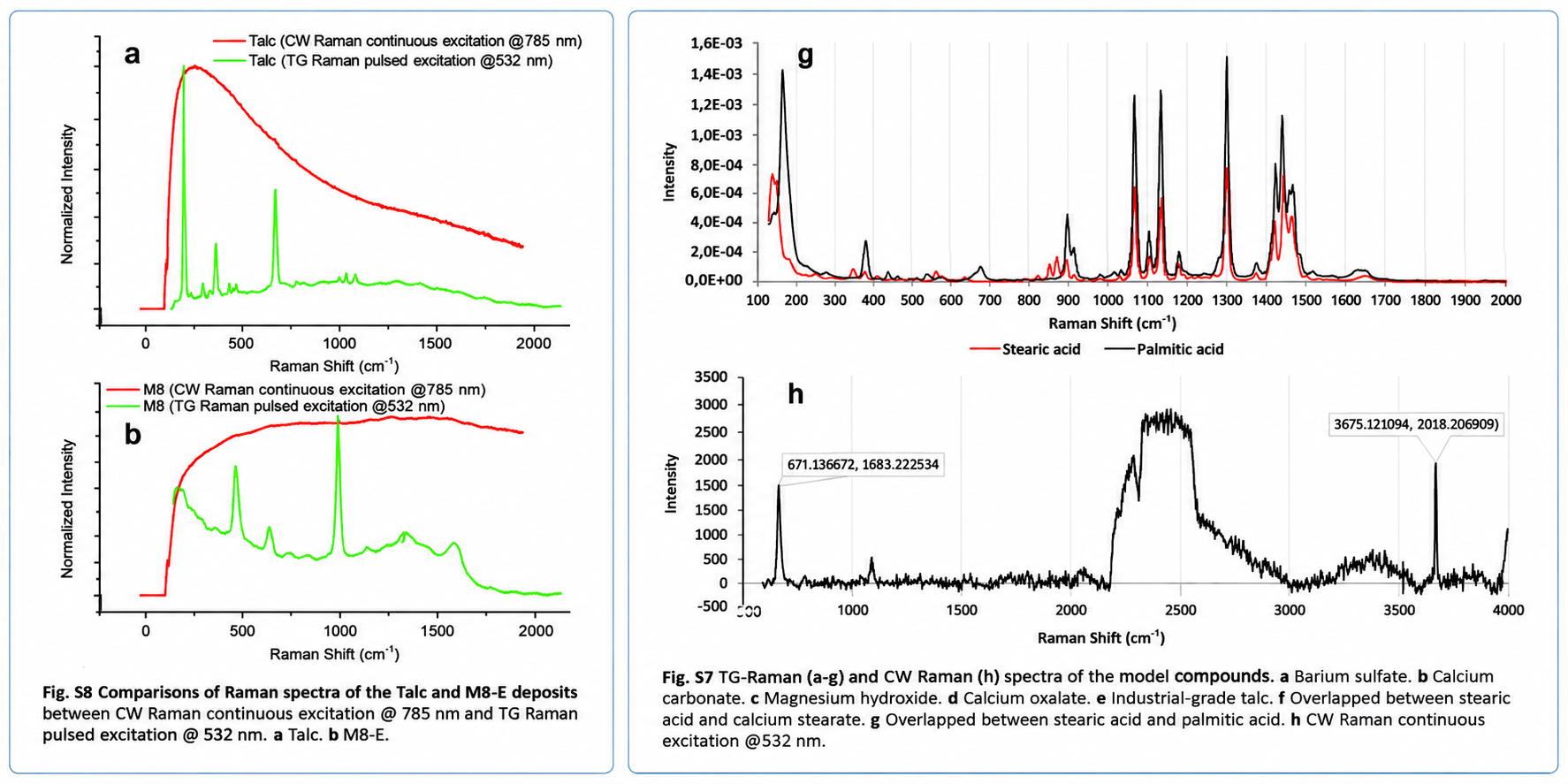
Timegated® Raman spectroscopy was one of the complementary analytical techniques used to characterize the deposits. Raman spectroscopy provides molecular information through the interaction of laser light with a sample. However, fluorescence from certain industrial materials can interfere with conventional Raman measurements, making characteristic Raman signals difficult to distinguish.
Timegated® Raman spectroscopy reduces fluorescence interference by separating Raman scattering from longer-lived fluorescence in the time domain. This can help reveal molecular information that might otherwise be obscured by background signals.
In this study, Timegated® Raman measurements using pulsed 532 nm excitation contributed to the identification and characterization of compounds in the pulp mill deposits. Together with the other analytical techniques, the measurements helped researchers investigate the complex composition of the samples.
The study highlights the potential of Timegated® Raman spectroscopy for analyzing challenging industrial materials, particularly where fluorescence interference can limit conventional Raman analysis.
What does this mean for industrial process analysis?
The research demonstrates the value of combining complementary analytical techniques when investigating complex industrial deposits. For pulp and paper manufacturers, understanding deposit composition can provide useful insights into the chemical processes behind deposit formation and help identify potential causes of operational problems.
The findings also highlight broader opportunities for Timegated® Raman spectroscopy in industrial research and process development:
- Analyzing complex materials: Obtaining molecular information from samples containing mixtures of organic and inorganic compounds.
- Reducing fluorescence interference: Improving access to Raman signals that may be difficult to distinguish using conventional Raman spectroscopy.
- Supporting process investigations: Providing chemical information that can help researchers understand material composition and process-related challenges.
- Complementing other analytical techniques: Combining Raman measurements with other methods for more comprehensive material characterization.
While the study focused on pulp mill deposits, the analytical challenges it addresses are relevant to other industrial processes involving complex materials and fluorescence interference.
From scientific research to industrial applications
The study provides an example of how Timegated® Raman spectroscopy can be applied to challenging industrial samples.
By combining Timegated® Raman measurements with complementary analytical techniques, the researchers gained a more comprehensive understanding of the chemical composition of pulp mill deposits.
The findings highlight the potential of Timegated® Raman spectroscopy as an analytical tool for industrial materials research, particularly in applications where fluorescence interference can make conventional Raman measurements challenging.
Original research source and licensing
This article is an independently written summary of the research. published in the Journal of Hazardous Materials Advances in 2026. Figures reproduced from the publication are credited to the original authors Jinze Dou, Maarit Lahtinen, Martin Kögler, Lassi Klemettinen, Klaus Niemelä, Kristoffer Meinander, Tiina Haatainen, Pekka Tervola and Janne Vehmaa..
The original publication Profiling of post-extracted pitch deposits of a softwood pulp mill by X-ray derived techniques (XPS, SEM-EDX, XRD) and time-gated Raman spectroscopy is licensed under the Creative Commons Attribution 4.0 International License (CC BY 4.0).