
Timegate Raman Technology Enabled Duquesne University’s Breakthrough Findings in Upstream Bioprocessing
Overview
In the rapidly evolving field of biomanufacturing, accurate, real-time monitoring of upstream processes is essential for ensuring consistent product quality and yield. Yet traditional analytical tools often struggle to distinguish key biochemical signals within complex cell culture environments.
At the 2025 AAPS PharmSci 360 conference in the U.S., researchers from Duquesne University, in collaboration with Pfizer Inc. and powered by Timegate’s Raman technology, presented compelling findings showing how Time-Gated Raman Spectroscopy (TGRS) outperformed conventional Raman spectroscopy (RS) in detecting key cell culture analytes.
The results, improved signal-to-noise ratio (SNR), lower limit of detection (LOD), and clearer Raman spectral peaks, highlight Timegate’s role in enabling breakthroughs in Process Analytical Technology (PAT) for the biopharmaceutical industry.
The Challenge: Fluorescence Masking in Bioprocess Monitoring
Biomanufacturing processes are becoming more complex, and with that complexity comes the need for more sophisticated analytical tools. Raman spectroscopy has become a preferred PAT method due to its rapid, non-invasive, and chemically specific detection capabilities. However, sample-induced fluorescence interference has remained one of its biggest limitations.
In traditional Raman spectroscopy, fluorescent signals emitted by cell media and other biological components often overwhelm weak Raman scattering, reducing the signal clarity and making it difficult to detect low-concentration analytes such as glucose, lactate, and ammonia.
As a result, RS typically detects glucose and lactate only at concentrations of 0.2–0.6.0 (Li et al. 2018), limiting its effectiveness in the later or sensitive stages of cell culture monitoring. This bottleneck has constrained the ability of manufacturers to move toward fully automated, real-time bioprocess control.
The Timegate Solution: Time-Gated Raman Spectroscopy (TGRS)
Timegate’s Time-Gated Raman Spectroscopy was designed to overcome exactly this problem.
By exploiting the temporal difference between Raman scattering (which occurs within picoseconds) and fluorescence emission (which lasts much longer, in nanoseconds), Timegate’s system uses ultrafast time gating to capture the pure Raman signal, while effectively filtering out fluorescence background noise.
This enables a dramatically cleaner, more accurate spectral response. Most importantly, the Timegate instrument allows these measurements to be made in situ, non-invasively, and in real time, making it ideally suited for upstream bioreactor monitoring.
“By synchronizing laser excitation with a time-gated detector, TGRS selectively captures Raman signals while minimizing fluorescence interference, improving detection sensitivity.” AAPS2025 Poster Nov 11th - Shaikat
The Study: Comparing RS and TGRS in Real Bioreactor Conditions
Led by Mahdi Mubin Shaikat, Ph.D. student at Duquesne University’s School of Pharmacy, the study evaluated the performance of TGRS versus RS in six independent CHO cell culture experiments.
The research team focused on five critical metabolites: Glucose, Lactate, Ammonia, Glutamine and Alanine.
Cultures were tested under two conditions, low cell density (LCD) and high cell density (HCD), to simulate realistic bioprocess environments. Using Net Analyte Signal (NAS) analysis, the team quantified the SNR and LOD for each analytes with both Raman instruments.
Results: Clearer Signals, Higher Sensitivity, and Reduced Noise
The data revealed a consistent and compelling trend: Time-Gated Raman outperformed Traditional Raman across all metrics.
- Sharper, more defined spectral peaks for all five metabolites (see Figures 1A–1D, p.4) (Shaikat et al. 2025).
- Significant improvement in Signal-to-Noise Ratio (SNR):
TGRS achieved higher SNR values across both low and high cell density conditions, confirming superior signal clarity (Shaikat et al. 2025). - Lower Limit of Detection (LOD):
TGRS detected metabolites at much lower concentrations than TRS, making it far more suitable for early-stage monitoring (Shaikat et al. 2025). - Monitor analytes concentrations continuously, without manual sampling.
- Predict process outcomes using chemometric models.
- Optimize bioreactor conditions dynamically to improve yield and consistency.
- Duquesne University provided research leadership and experimental design.
- Pfizer Inc. contributed scientific expertise..
- Timegate Instruments supplied the enabling Raman technology that made the breakthrough possible.
- This work was performed in collaboration with Pfizer, Inc and was performed under a Project Award Agreement from the National Institute for Innovation in Manufacturing Biopharmaceuticals (NIIMBL) and financial assistance award 70NANB21H086 from the U.S. Department of Commerce, National Institute of Standards and Technology (NIST). AAPS2025 Poster Nov 11th - Shaikat.
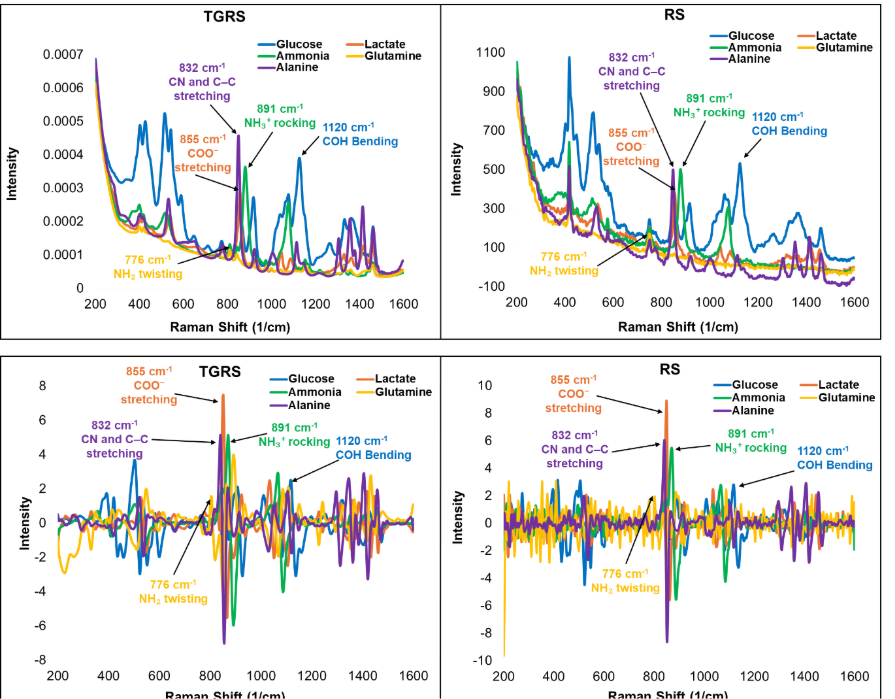
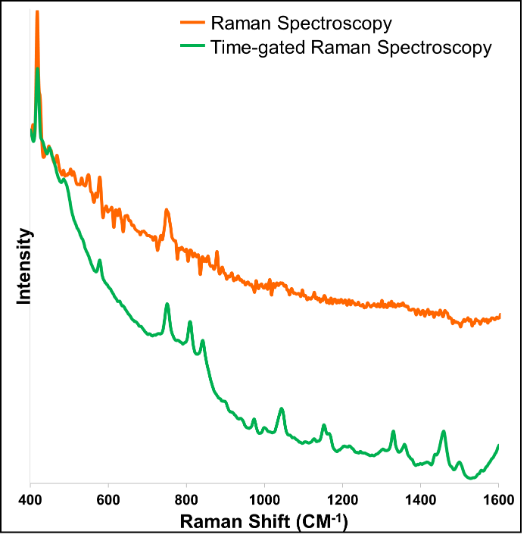
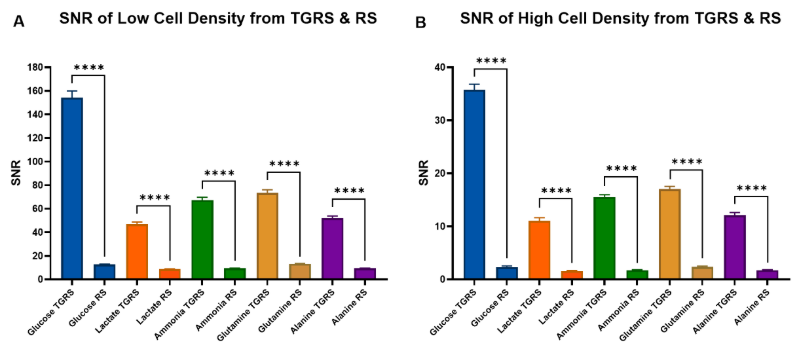
In visual comparisons (Figures 2 and 3, pp. 5–6), Timegate’s technology consistently demonstrated 2–5× better performance in SNR and notably reduced LOD across all five metabolites.
“Superior SNR and LOD results supported that TGRS enhances signal clarity and reduces background noise, improving metabolite differentiation and quantification over TRS.” AAPS2025 Poster Nov 11th - Shaikat
Impact: Enabling Real-Time Bioprocess Control
The implications of this study go well beyond academic curiosity. In an era where continuous manufacturing and PAT integration are key to regulatory and operational excellence, Timegate’s technology provides the missing piece; reliable, fluorescence-free Raman data for real-time decision-making.
By integrating TGRS probes directly into bioreactors, researchers and manufacturers can now:
This opens new possibilities for the biopharma industry, where process transparency, automation, and data-driven control are becoming the standard for next-generation biologics production.
Collaboration and Credibility
This research represents a strong model of academic–industry–technology collaboration:
The findings validate Timegate’s leadership in time-resolved Raman spectroscopy and signal the next step for real-time bioprocess analytics. Future work will focus on scaling the technology for full bioreactor integration and extending its application to other biopharmaceutical and fermentation systems.
As biomanufacturing continues to evolve, Timegate Raman technology stands as a critical enabler for smarter, cleaner, and faster process control.
Key Takeaway
Time-Gated Raman turns the invisible into insight.
By filtering out fluorescence interference, Timegate’s technology allows scientists to see, and measure, what was once hidden.
The Duquesne University study is a testament to how scientific innovation, industry collaboration, and advanced technology together accelerate progress in biomanufacturing.
References:
- Shaikat, M.M., Dhara, V.G., Drennen, J.K. et al. Enhancing analytical sensitivity in upstream bioprocess using time-gated Raman spectroscopy. Bioprocess Biosyst Eng (2025). https://doi.org/10.1007/s00449-025-03261-y
- Li M, Ebel B, Chauchard F, Guedon E, Marc A. Parallel comparison of in situ Raman and NIR spectroscopies to simultaneously measure multiple variables toward real-time monitoring of CHO cell bioreactor cultures. Biochemical Engineering Journal. 2018 Sep 15;137:205-13.