FAQ: Which Probes Can I Use with PicoRaman?
FAQ series: This series of publications explores some of the most frequently asked questions regarding Timegated® spectrometers and measurements without having you read page after page of text.
We first published this FAQ episode in 2021, and many advancements have taken place since then. An up-to-date text discussing currently available probe and sampling options should prove to be informative for anyone interested in using a Timegated® PicoRaman M3 spectrometer for their measurement applications. As this text aims to collect most relevant probe/sampling option information into a single piece of text, it is a bit longer than most of the other FAQ series texts.
General Probe Compatibility
PicoRaman M3 spectrometers are designed to work well with a wide range of first- and third-party measurement probes. Due to the spectrometer design and 532nm excitation wavelength, the probes must still fulfil a basic set of requirements which are listed below. Please contact the Timegate Instruments team to verify probe compatibility.
Probe requirements:
- Compatible FC/PC connectors
- 105µm excitation fiber
- 300µm collection fiber (can be smaller, but some collection efficiency may be lost)
- Compatible with 532nm excitation (probe filters chosen for this wavelength)
- Due to the time-resolved aspect, the probe’s optical cable length should preferably be 5 meters or shorter.
Options Offered by Timegate Instruments
While the PicoRaman M3 spectrometer is compatible with third party options, Timegate Instruments offers several first party sampling options that are tailor-made for the spectrometer. See the Timegate Instruments product page for more information.
ProbePro Mini
The ProbePro Mini is a versatile sampling option. The probe’s body is compatible with a wide range of optics solutions and interfaces. The optics tubes/shafts can be removed and replaced by another configuration while using the same probe body.
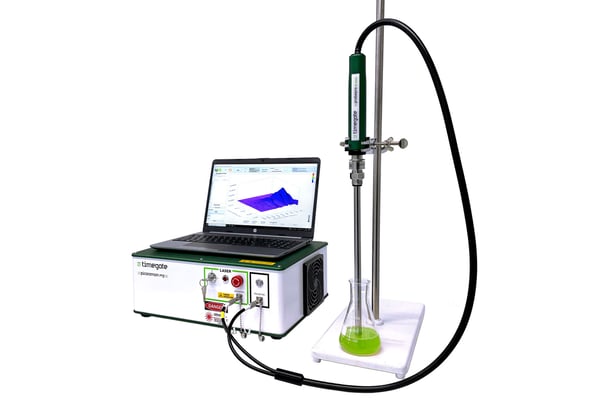
ProbePro Mini
The ProbePro Mini probe is designed for immersion measurements, it is compatible with several bioreactor interfaces, and it can also be used in a flow cell configuration. The latest addition to the ProbePro Mini is the long working distance optics option.
A Schott® ViewPort® or ViewCell® interface component is attached to the ProbePro Mini around the probe’s optics shaft. The Schott® components can be autoclaved which enables sterile bioreactor measurements. The ProbePro Mini supports both PG 13.5 and shorter Ingold interface options. The ProbePro Mini also supports ViewPort® Single Use options for single-use bioreactors.
The ViewCell® configuration functions as a flow cell. It includes tubing attachment points and liquid can be pumped through the measured sampling volume.
The ProbePro Mini can also be used in a laboratory setup by simply immersing its tip in liquids, slurries or gels and carrying out measurements in this minimal sample preparation requiring configuration.
The ProbePro Mini’s Long Working Distance (LWD) optics solution enables measurements from samples that are further away from the probe. The default working distance, distance between the probe’s tip and the sample surface, is 60mm. This enables easier measurements through window materials and the LWD can be especially useful for high-temperature measurements where the distance between the sample and the measurement equipment is vital. Learn more about MicroProbe & ProbePro Mini .
BAC100 Non-Contact Probe and SampleCube
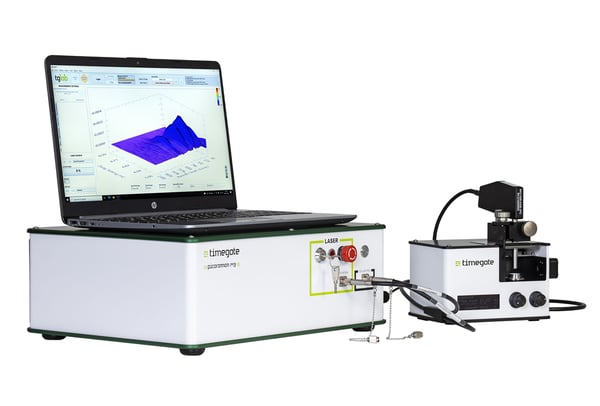
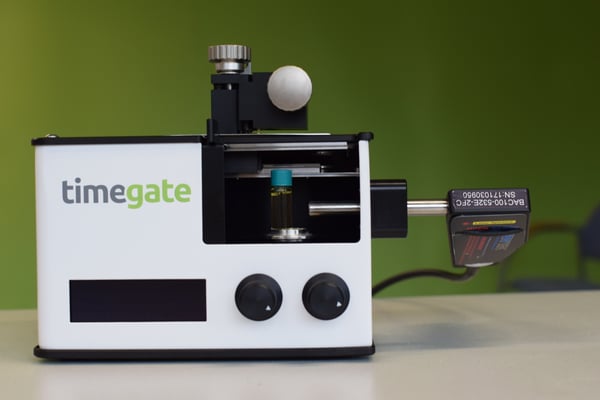
The BAC100 non-contact probe is a versatile sampling option that can be slotted into a SampleCube. The probe has a working distance of 5.4mm which enables direct measurements and measurements through windows, vials, and cuvettes.
The main use with the non-contact probe and SampleCube combination is powder measurements. A sample cup can be placed within the SampleCube and the SampleCube rotates the sample cups while also moving the probe back and forth. This creates a movement that enables the probe to automatically measure a larger sample surface area for more representative results. The user can adjust the measured surface area and scanning speed. Some application areas where the SampleCube powder measurements are practical include pharmaceuticals, catalysis research, geological samples, polymers, and many other applications where the aim is to produce representative measurement results from powders. Learn more about Sample Cube
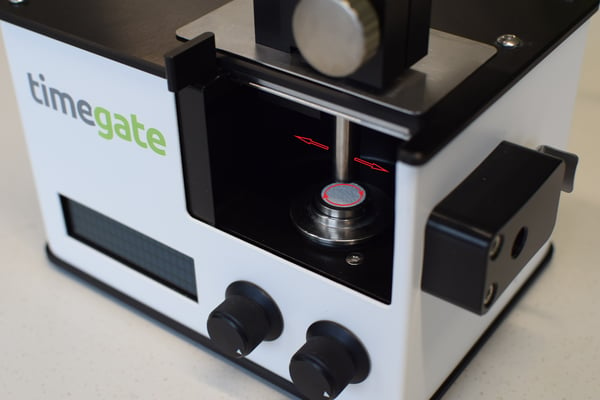
The probe can also be attached to the SampleCube horizontally for measurements through vials and cuvettes. The vial can be placed inside the SampleCube and the SampleCube’s sliding door can be closed for additional eye safety when using the excitation laser during measurements.
MicroPlate HTS System
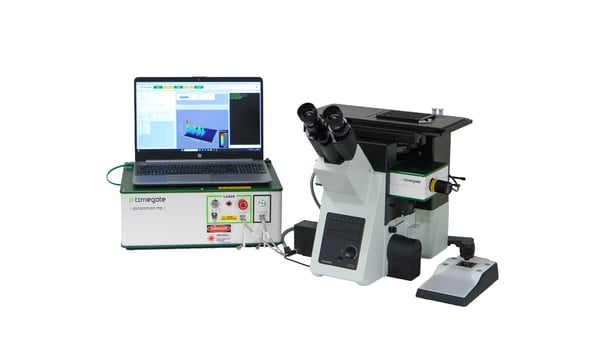
The MicroPlate HTS (High-Throughput Screening) System enables automatic measurements from 96 well microplates. Glass-bottom microplates are used, and the measurements are carried out from below through the glass. This brings many advantages including not having to think about sample surface level changes as the material evaporates, not having to worry about frothing on the sample surface, and being able to seal the top of the microplate.
The HTS System includes the option to carry out adjustable scanning grid measurements from each well. The system is well suited for measuring liquids and suspensions and some of the application fields include cell culture samples, pharmaceutical formulation samples, and many other applications where a high number of samples are generated and manual measurements would be time-consuming. The HTS System is also an invaluable sampling option when the sample material is scarce, and it is only available in the tens of microliters. Learn more about MicroPlate HTS System.
MicroProbe
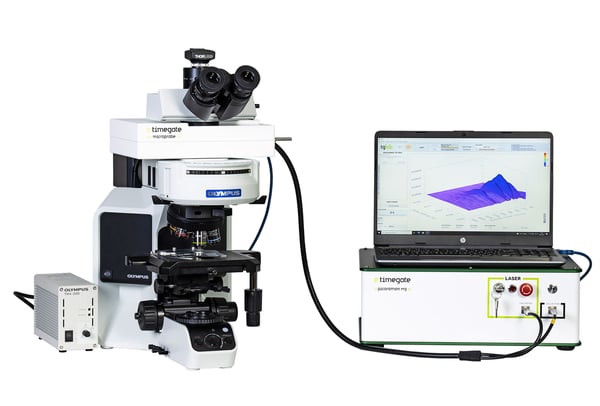
MicroProbe is the go-to option when measuring individual microscopic objects. The MicroProbe solution can be attached to most Olympus BX, CX, and MX series upright microscopes and it connects the microscope to a PicoRaman M3 spectrometer.
The MicroProbe includes an integrated camera that enables observing the sample on a screen and taking photos of the sample. The measurements are convenient as the user first focuses the microscope view on the sample’s area of interest and then starts a measurement with the PicoRaman M3 spectrometer.
The microscope can still be used with different objectives, and the objective type and magnification can be used to adjust certain measurement parameters including the illumination/excitation spot size (is the measurement carried out from a smaller or larger surface area). It is common to use e.g. 10X – 100X magnification objectives and with this range the excitation spot sizes range from ca. 210µm to 21µm.
The MicroProbe solution is used in a wide range of applications including measuring inclusions from geological samples, identifying individual impurities from polymers or semiconductors, measuring layers of pigments, and many other cases where small sample fractions are of interest.
High-Temperature Measurements
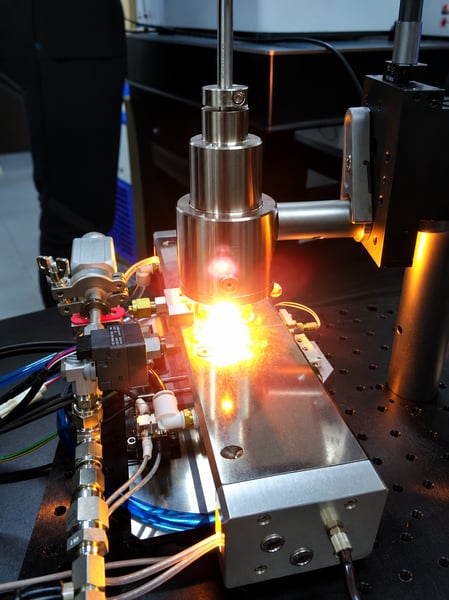
One of the advantages of Timegated® measurements is its inherent capability to suppress thermal emission interference. This is crucial when measuring high-temperature samples and the PicoRaman M3 spectrometer has been used to measure materials that were heated to >2000°C temperatures during measurements. The advantage is based on the pulsed excitation where also the detected Raman signal is pulsed and the detector is only activated during the signal pulses while being in a non-collection state during most of the continuous thermal emission. See this blog post for more information:
Laboratory-scale high-temperature measurements are often carried out using heating stages. The material is heated within the stage, and the sample is measured through a window. Several measurement configurations can be used for stage measurements including the BAC100 non-contact probe, MicroProbe with a long working distance objective, and ProbePro Mini with long working distance optics. The BAC100 probe can also be equipped with a high-temperature adapter that extends its working distance and enables gas flow-based cooling (see previous blog link for more details).
PicoRaman M3 has also been used to measure high-temperature samples that are not confined to a heating stage. For these cases the ProbePro Mini with long working distance optics may be the most versatile option. While the measured samples can be heated to very high temperatures, the probes are precise optical equipment that can’t be heated to very high temperatures. This challenge is usually solved by maximizing the distance between the probe and the sample, using very localized heating (e.g. laser heating), cooling the probe and/or isolating the sample’s heat from the probe.
The aim with high-temperature measurements is usually to see material changes as a function of temperature or at certain temperatures. The interest in operando measurements is also increasing where the measured material is actively functioning under real operating conditions. Some of the high-temperature application fields include metallurgy and minerals (melting, roasting, calcination and slag formation), ceramics and glass (crystallization, sintering and melting), and catalysis (surface species, deactivation, and regeneration). Learnmoe about High-temperature measurements.
Author
 This blog was written by Timegate Instruments’ Application Team Lead Bryan Heilala. Bryan is a young and energetic chemist with a degree in M.Sc. (chemistry) and experience and background in analytical chemistry.