Timegate’s Raman Technology Supports Real-Time Bioproduction Monitoring at KTH Royal Institute of Technology
Challenge
KTH Royal Institute of Technology (Kunglika Tekniska Högskolan) in Stockholm is one of Europe’s leading technical universities and a core partner in advancing sustainable and efficient bioproduction. The work is conducted within the AdBIOPRO Competence Centre, a national research initiative focused on transforming today’s bioproduction into continuous, intensified, and highly automated bioprocesses. AdBIOPRO brings together industry and academia to develop the tools, methods, and analytics needed to industrialize next-generation biomanufacturing.
Within this framework, KTH’s Cell Technology Group explores new ways to improve bioproduction efficiency, reduce production costs, and enhance real-time process control.
Timegate Instruments contributes to this mission by providing fluorescence-free, real-time molecular monitoring solutions for life sciences, materials research, and industrial process control.
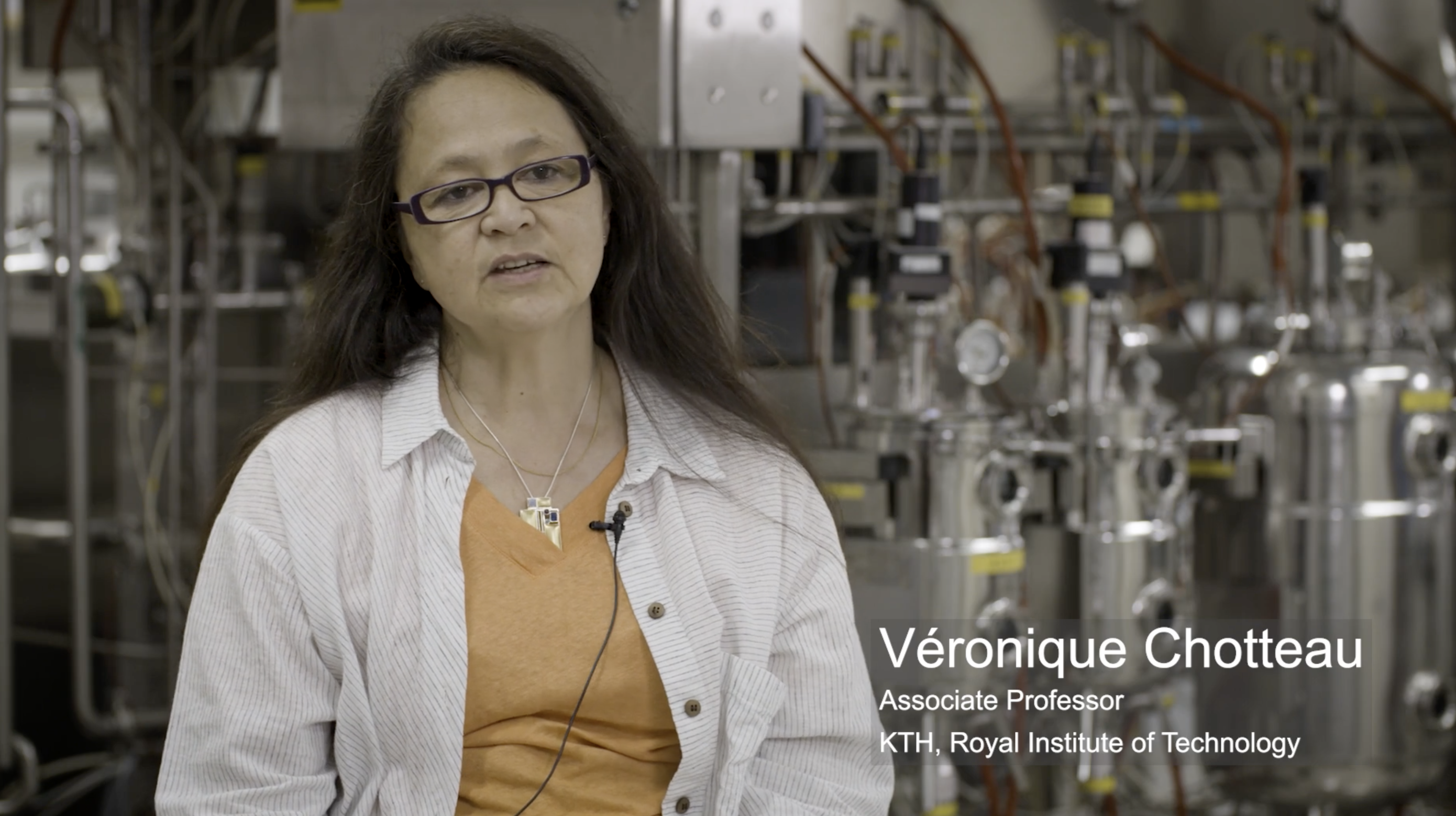
“Stem cell therapies are revolutionising medicine, but producing high quantities of high-quality cells remains complex and expensive. The challenges include high cell number requirements, labour-intensive manual processes, limited real-time process monitoring, and sensitivity of differentiation to environmental changes,”
says Professor Veronique Chotteau, KTH Royal Institute of Technology.
“We want to find new ways to cut costs and improve process efficiency and quality.”
To address these challenges, the KTH team within the AdBIOPRO programme set out to develop a continuous perfusion bioprocess for human induced pluripotent stem cells (hiPSCs). A key objective was to evaluate real-time Raman spectroscopy as a tool for enhancing process control, ensuring consistent culture quality, and supporting the transition toward continuous biomanufacturing, one of AdBIOPRO’s central goals.
Timegated® Raman was integrated into the perfusion bioreactor to:
- Monitor key metabolites (glucose, glutamine, lactate, ammonia, and LDH) in real time
- Evaluate cell health and differentiation states non-destructively
- Build robust chemometric models to predict metabolite concentrations directly inside the bioreactor
- Reduce reliance on manual sampling—aligning with the AdBIOPRO aim of enabling automated, data-driven bioprocessing
Results
Using Timegate’s Timegated® Raman instrument, the researchers achieved accurate prediction of multiple metabolites in real time. Models calibrated with well-plate data enabled the continuous estimation of: Lactate, Glucose, Glutamine, Ammonia and Lactate dehydrogenase (LDH)
The study demonstrated that Timegated® Raman spectroscopy enables label-free, real-time process monitoring even in complex stem cell cultures, aligning directly with AdBIOPRO’s focus on replacing manual measurements with online analytics.
The KTH team showed how advanced optical analytics can transform cell culture monitoring by offering:
- Reduced manual sampling and process variability
- Improved understanding and control of critical process parameters (CPPs)
- A scalable and automated approach toward industrial bioproduction, including amino acid separation and continuous processing
- Non-destructive assessment of cell health and differentiation
The calibration datasets provided a strong foundation for predictive chemometric models suitable for continuous bioprocess environments—an important step toward the industrialisation goals of the AdBIOPRO programme.
“Timegated® Raman technology and the expertise of Timegate Instruments have helped us monitor key metabolites in real time without disturbing the cells.
The technology has improved process control inside the bioreactor by creating a better model for monitoring and optimising cell nutrition sources.
We have been able to limit fluorescence interference and achieve reliable, continuous stem cell bioproduction.
The instrument has performed as well as, or even better than, we expected,”
says Veronica.
Collaboration Impact
“This collaboration highlights the role of advanced optical sensing in accelerating the transition from research-scale bioprocessing to industrial biomanufacturing,”
says Mari Tenhunen, CEO of Timegate Instruments.
The work between KTH and Timegate Instruments demonstrates how fluorescence-eliminated Raman spectroscopy supports the next generation of bioprocessing, continuous biomanufacturing, and cell therapy production, key ambitions of the AdBIOPRO Competence Centre.
KTH Royal Institute of Technology
KTH Royal Institute of Technology (Kungliga Tekniska Högskolan) is Sweden’s largest and one of Europe’s leading technical universities. With a strong focus on engineering, biotechnology and sustainable production, KTH works closely with industry to advance research from laboratory scale to real-world applications. Through initiatives like the AdBIOPRO Competence Centre, KTH plays a key role in developing next-generation bioprocessing and biomanufacturing technologies.