New Study on Analytical Sensitivity in Upstream Bioprocess
December 20, 2025 – A new study published in Bioprocess and Biosystems Engineering demonstrates how Time-Gated Raman Spectroscopy (TGRS) significantly improves analytical sensitivity for monitoring complex upstream bioprocesses — a development with strong implications for real-time process control in biopharmaceutical manufacturing.
Why This Matters
Bioprocessing, especially mammalian cell culture like CHO (Chinese Hamster Ovary) systems, depends on accurate, real-time monitoring of key analytes (e.g., glucose, lactate, ammonia, glutamine, alanine). Conventional inline process analytical tools like standard Raman spectroscopy are valuable but limited by fluorescence interference, which reduces sensitivity and increases the limit of detection (LOD).
What Time-Gated Raman Spectroscopy Changes
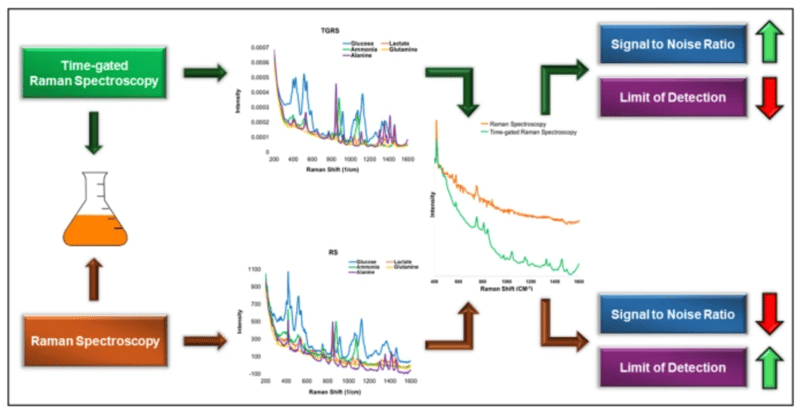
Time-Gated Raman Spectroscopy uses the time delay between Raman scattering and slower fluorescence emission to suppress background noise, enabling clearer detection of chemical signals even in complex media. By synchronizing laser pulses with detector timing, TGRS selectively captures Raman signal while minimizing fluorescence.
In this study, researchers applied a pure component modeling approach and Net Analyte Signal (NAS) analysis to evaluate how TGRS compares with traditional Raman in CHO cell culture samples.
Key Results
- Improved Signal-to-Noise Ratio (SNR): TGRS demonstrated consistently higher SNR than traditional Raman across all five analytes, making spectral features much clearer and more reliable for monitoring.
- Lower Limits of Detection: TGRS significantly reduced LOD values — in some cases by orders of magnitude — enabling earlier detection of metabolic changes that could inform process adjustments sooner.
- Better Chemical Resolution: The NAS analysis revealed sharper, more distinct Raman peaks in TGRS data, indicating reduced spectral interference and improved analyte specificity.
Why It’s a Breakthrough for PAT
This work highlights how TGRS can enhance Process Analytical Technology (PAT) by enabling more sensitive, accurate, and inline measurement of key variables in cell culture — a crucial capability for real-time monitoring, process control, and optimization. The improved analytical performance supports robust decision-making and could help advance automation and precision in biomanufacturing.
Looking Forward
The authors note that future efforts will focus on developing chemometric models to translate TGRS signals into quantitative process insights within dynamic bioreactor environments, further unlocking the technology’s potential for industrial use.
👉 Read the original article:
https://link.springer.com/article/10.1007/s00449-025-03261-y